We call it the Big Bang!
And the first crack in our confidence appears immediately: what was before it?
When we ask what came before, we are already trapped inside time, using a tool that may not apply.
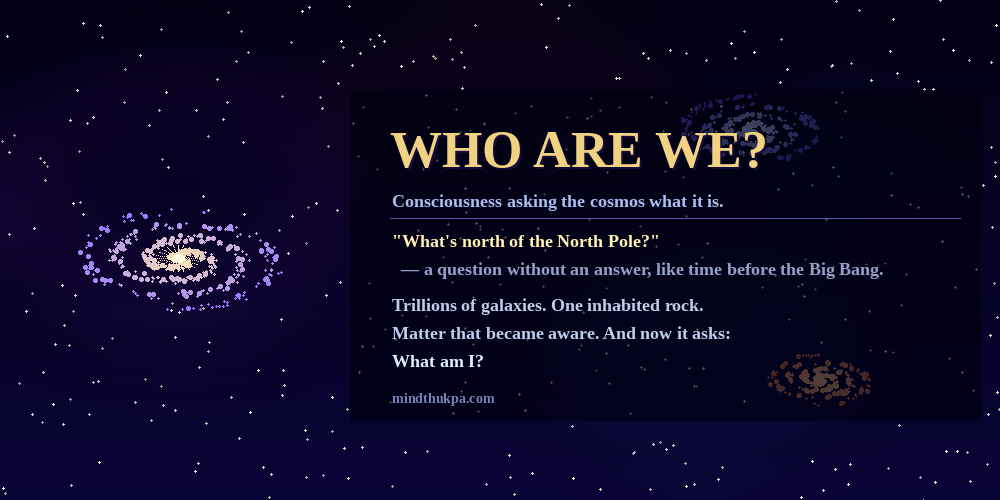
As Stephen Hawking warned, asking “What came before the Big Bang?” may be like asking, “What’s north of the North Pole?” If time began there, “before” may be a word without meaning.
But the mind refuses to stop there.
If there was nothing, how did something appear?
If there was something, what sustained it?
If there was a God, who created God?
If God needs no creator, why does the universe?
Believers speak of intention, of destiny – events written, fixed, unfolding exactly as scripted. Some insist every breath is predetermined.
Atheists respond with a colder elegance: no author, no script. The universe simply is! Matter arranged itself into life; and life into thought. There was nothing before you; there will be nothing after you. This is your single flare in an otherwise indifferent cosmos – a brief accident between two infinities of silence.
Both positions feel bold. Both feel incomplete.
Now step back.
Our galaxy, the Milky Way, holds somewhere between 100 and 400 billion stars. Many of them have planets. The observable universe may contain trillions of galaxies. TRILLIONS! The number is so large it stops behaving like a number.
The scale is not just large – it is annihilating. It erases intuition.
And yet, here is the humiliating truth:
The farthest humans have ever traveled was during the Apollo 13 mission in 1970 – about 400,000 kilometers from Earth.
No human has ever gone beyond the Moon.
That is our cosmic footprint. A fraction of a pixel in astronomical terms.
Meanwhile, Voyager 1 – a small robotic machine – has drifted over 24 billion kilometers away and entered interstellar space. And even that staggering distance is still inside one galaxy among trillions.
We speak confidently about reality while standing on the porch.
Are we alone?
Given the numbers, it feels absurd to say yes.
And yet – silence!
No signal. No visitor. No confirmed whisper from elsewhere.
This tension has a name: the Fermi Paradox. If life is common, where is everybody?
Maybe life is rare.
Maybe intelligence self-destructs.
Maybe the distances are insurmountable.
Maybe we are early – the first flicker in a dark room.
Maybe we are not looking correctly.
Or maybe reality is stranger than the question itself.
What if the universe is not a single unfolding story, but a branching one?
Imagine that every quantum event does not choose one outcome but all of them – every possibility real, every path taken. Each decision – yours, mine, every organism that ever twitched – splits the fabric. A quiet multiplication. A silent divergence.
Now Multiply that by cosmic time.
Eight billion humans. Trillions of organisms. Countless interactions per second. Each with alternatives. Each with forks in the road.
The permutations explode beyond comprehension.
In one universe you never read this.
In another, humanity never evolved.
In another, the stars formed differently.
In another, intelligence bloomed everywhere.
Perhaps expansion is not just space stretching, but possibility multiplying – a cosmic tree branching endlessly – new branches, new timelines, new versions of you who turned left instead of right, spoke instead of stayed silent, lived instead of died. It’s possible other civilizations may not be far away in distance, but in dimension – adjacent in possibility, unreachable by physics we barely understand.
Or consider something more unsettling.
What if we are not nature’s first experiment here?
What if some ancient intelligence seeded this planet? Engineered life. Watched it evolve. And what if we surpassed them – outcompeted, outnumbered, erased them without even knowing?
Evolution does not care about creators.
Now look at us building artificial intelligence. Systems that learn faster than we do. Adapt faster. Improve themselves. What if intelligence always replaces its origin? What if one day this planet belongs to minds that see us the way we see early primates – necessary ancestors, now obsolete?
We like to think we are the pinnacle.
Cosmically, we have barely left home.
Biologically, we arrived yesterday.
Geologically, we are a blink.
And yet, atoms forged in ancient stars have arranged themselves into brains capable of doubting the universe that formed them.
We are impossibly small. And impossibly strange.
Whether destiny is written or nothing is written at all… whether God exists or existence is its own brute fact… whether reality is singular or branching beyond comprehension…
One truth remains:
On a small rock orbiting an ordinary star, in one galaxy among trillions, after traveling no farther than a neighboring moon, matter has become aware, and it is asking what it is!