Tasneem ordered a 'Mutton Dum Pukht Biryani with aloo and plums' via' Zomato from Social Powai. We had actually been planning to order one on Eid, but like many noble plans in life, it somehow never materialized.
So, this order wasn't just dinner. It was unfinished business.
When the delivery finally arrived, anticipation was at an all-time high. The aroma was promising, the packaging looked respectable, and for a brief moment it seemed that the universe had decided to be kind.
Then reality struck - the biryani had chicken instead of mutton, and some aloo... but plums? Well, the plums had apparently exercised their constitutional right to remain absent. Tasneem, hungry as she was and emotionally invested in this particular biryani, was furious. It wasn't merely a food-order mistake, it was the complete destruction of a culinary experience she had really been looking forward to.
Naturally, she turned to the delivery app, Zomato, to seek justice.
What she did not yet know was that she was about to encounter one of the most formidable institutions of the modern age:
The AI-powered customer support system.
Or, as future historians may refer to it, "The Great Digital Wall"
She opened the app and clicked on the Help section.
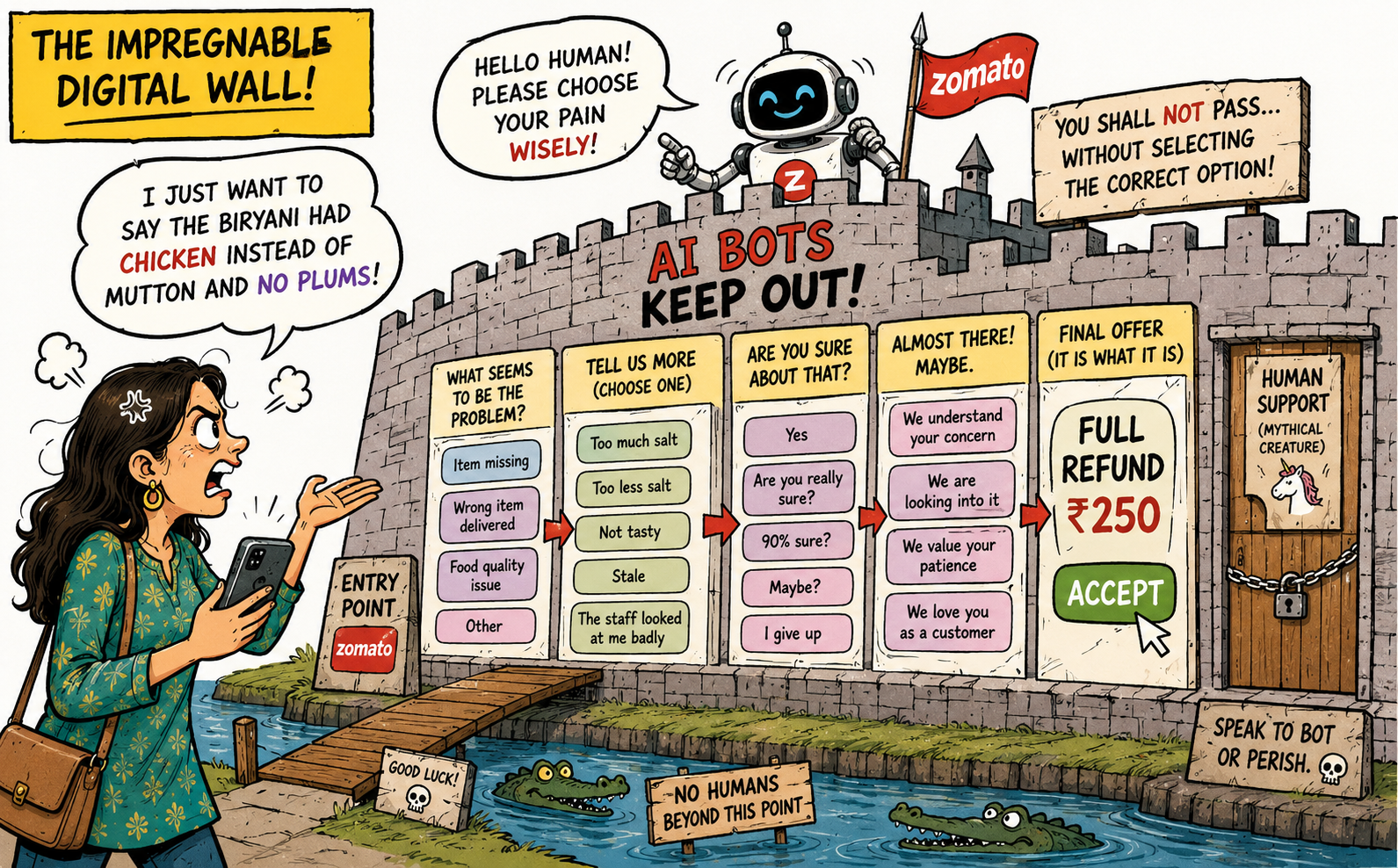
Soon she discovered that there was no provision whatsoever for typing her complaint.
No text box. No chat window. No opportunity to explain that the mutton in her biryani had somehow undergone a miraculous evolutionary reversal and become chicken.
Instead, she was presented with a series of pre-set options, presumably designed by some deeply frustrated engineer sitting in a forgotten corner of a vast IT office, assigned the digital equivalent of sorting paperclips and determined to channel every ounce of accumulated resentment into the customer experience.
At first, the options appeared broad and sensible enough.
☐ Item missing.
☑ Wrong item delivered.
☐ Food quality issue.
Fair Enough.
But as Tasneem proceeded further, the options became increasingly detached from reality.
It felt less like troubleshooting an order and more like participating in a government-sponsored psychological experiment. Each subsequent menu seemed specifically designed to move farther away from the actual problem and into an alternate dimension where facts were merely suggestions.
At one point, it felt entirely plausible that the next option might be:
"Have you considered that the chicken identifies as mutton?"
Or perhaps:
"Would you describe your disappointment as mild, moderate, or existential?"
All available options seemed remarkably distant from the actual issue. Since there was no way to chat, explain, type, clarify, elaborate, narrate, plead, negotiate, or simply communicate like a human being, her task now became selecting whichever option was least detached from reality.
Notice how I casually said that this had now become her task. Not Zomato's. Hers. And you probably didn't even blink. That's how thoroughly we've been trained. Somewhere along the way, customer service quietly became customer labour. If something goes wrong, your job is now to diagnose it, categorize it, classify it, and squeeze it into one of the approved boxes. Soon enough hospitals will have us selecting our own surgery from a drop-down menu. Yet somehow, when a food app does it, we obediently begin our unpaid shift as Associate Customer Support Executives.
I can't even say she was trying to choose the option "closest to the issue," because that threshold had been crossed many screens earlier during her rendezvous with Zomato's state-of-the-art AI technology.
So, there she was:
Armed with a disappointing biryani.
No plums.
Half an aloo.
Chicken masquerading as mutton.
And a burning desire for justice.
Just justice.
 Then something miraculous happened.
I saw her face light up.
(I swear I did) Even if only for a millionth of a second.
The AI Bot offered her a FULL REFUND.
Those magical words appeared on the screen.
For a brief moment, balance was restored to the universe.
The oppressed had prevailed.
Truth had triumphed.
The system worked.
But, of course, like many moments of joy in Tasneem's life, this one was tragically short-lived. Because she soon realized that the refund amount had already been predetermined by the AI.
The "FULL REFUND" was exactly Rs.250/-
The inconvenient fact that the biryani itself had cost nearly Rs.600/- appeared to be of no concern whatsoever to our silicon-based adjudicator.
This made her furious all over again.
I distinctly heard her exclaim:
"Unacceptable."
Now, over the years, I have heard Tasneem use that word only twice.
The first time was when 9/11 happened.
The second occasion is slightly hazy in my memory, but I would comfortably wager half a 'Mutton Dum Pukht Biryani' that it occurred sometime shortly after our wedding.
So, I knew this wasn't a word she used casually.
Zomato had crossed a line.
A very serious line.
And they had absolutely no idea what was coming their way.
Tasneem now began furiously pressing every button she could find in search of a way to speak to an actual human being.
A customer service representative.
A real person.
A member of our species.
In doing so, she temporarily forgot the entire purpose of modern AI-powered customer service is to avoid human-to-human contact. It’s designed to ensure that customers never come into contact with anyone capable of solving them.
The old middle-class luxury of speaking to a human being has quietly become a premium feature. Much like airport lounges, business class seats, and houses with sea views.
Human customer support is now reserved for the deserving classes.
The top 1%.
The people whose complaints begin with phrases like: "I'd like to speak to my relationship manager."
The rest of us are assigned to Algorithm Raj.
A vast digital bureaucracy where no one is responsible, no one is available, and no one can hear you scream into your biryani.
After exhausting every possible menu, sub-menu, hidden menu, alternate menu, and menu pretending not to be a menu, she finally reached the last stage of grief:
Acceptance.
Or perhaps resignation.
Or perhaps the specific type of numbness that comes from arguing with software.
Then a thought occurred to her.
Maybe there had been some technical mistake.
Maybe the bot wasn't malicious.
Maybe it had simply mixed up the numbers.
After all, ‘dil ka bura nahin hai’.
Perhaps somewhere deep inside its neural networks, beyond the layers of machine learning and optimization algorithms, there existed a tiny digital heart trying its best.
So, she decided to start over.
From the very beginning- Patiently, methodically…
She retraced every step.
Selected every option again.
Answered every question.
Navigated every absurd branch of the decision tree.
And after repeating the entire process from scratch, she arrived exactly where she had started.
The AI Bot once again triumphantly offered her a FULL REFUND - Of Rs.250, Not Rs.249, Not Rs.251.
Exactly Rs.250/-.
At that moment, it became clear that this was not a negotiation.
This was doctrine.
The bot had spoken.
And the bot, unlike humans, never doubts itself.